Sicily
Greek temples, Arab-Norman cathedrals, Mount Etna's slow exhale — Sicily layers civilizations the way its cooks layer caponata.
Five reasons Sicily stays with you.
- Greek temples at Agrigento and Segesta — better than most in Greece
- Active Mount Etna, climbable year-round
- Arab-Norman cathedrals layered with mosaic
- A cuisine of Arab, Greek, Spanish and African influences
- Wild beaches on the Aeolian and Egadi islands
Best time to visit · April–June and September–October. Etna snow-capped Dec–March.
The Crossroads of the Mediterranean
No place in Italy has been conquered, courted, and shaped by as many civilizations as Sicily — and all of them stayed in the stone. The Greeks came first, from the 8th century BC, founding Syracuse, Agrigento, and Selinunte and building temples that still stop visitors cold; Syracuse grew so powerful it defeated Athens and briefly rivaled it as the greatest city of the Greek world. Rome made the island its granary, but the Greek language and culture lingered for centuries.
Then came the transformation that makes Sicily unlike anywhere else. In the 9th century the Arabs arrived, and over two centuries they remade the island — citrus and almond groves, sophisticated irrigation, and a Palermo that grew into one of the largest, most cosmopolitan cities on earth. When the Normans took over in the 11th century, they didn't erase what they found; they fused it. Under Roger II in the 12th century, Arabic, Greek, and Latin circulated in the same court, and Byzantine mosaics were laid into churches built on Islamic proportions — the singular "Arab-Norman" style you can still see at Monreale, Cefalù, and Palermo's Palatine Chapel.
A Baroque Born from Catastrophe
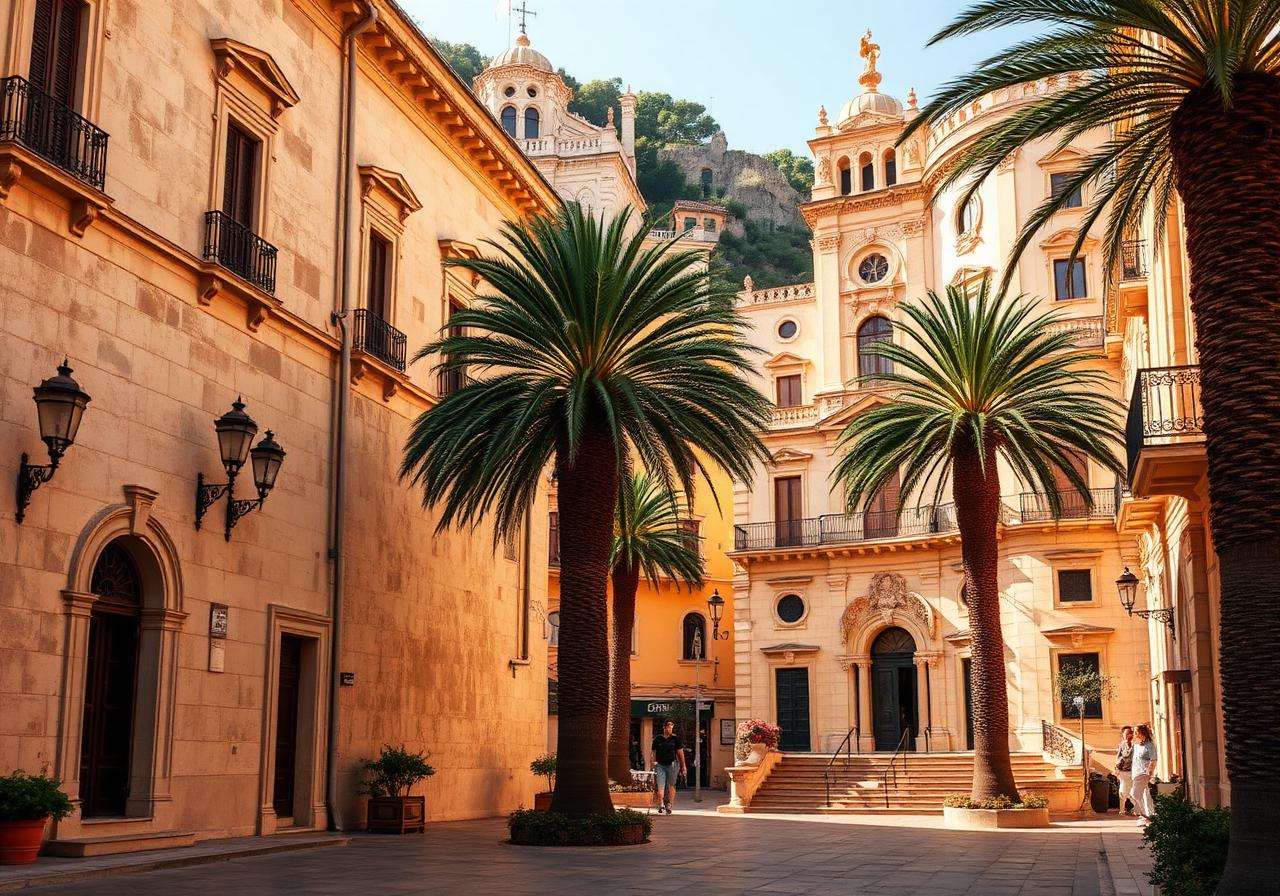
In 1693 a catastrophic earthquake leveled southeastern Sicily. The rebuilding became one of Europe's great artistic moments: the late-Baroque towns of the Val di Noto — Noto, Modica, Ragusa, Scicli — raised whole cities at once in honey-colored limestone, ornament pushed almost to delirium. Spanish rule, Bourbon kings, and finally Garibaldi and Italian unification in 1860 each added another layer.
An Island That Accumulates
Sicily never replaces itself — it accumulates. You taste it as much as you see it: Arab-introduced spices and citrus, the cold-worked chocolate of Modica still made by a technique the Spanish carried from the Aztecs, Bronte pistachios, almond granita, and Nero d'Avola from the volcanic soil near Etna. Greek temples, Arab domes, Norman mosaics, Baroque facades, and a volcano that has watched all of it — that is Sicily.
Start here if you have a long weekend.
Baroque towns, volcanic soil, an island unto itself.
Five doorways into Sicily — each town with its own light, language, and rhythm.
Noto
A honey-colored baroque stage rebuilt after the 1693 earthquake.
Ortigia (Syracuse)
An island within an island — Greek temple bones holding up baroque facades.
Cefalù
A fishing town under a Norman cathedral and a brooding rock.
Modica
Stacked baroque town famed for cold-worked Aztec-style chocolate.
Taormina
A theatrical balcony town between Etna's smoke and the Ionian Sea.