Sardinia
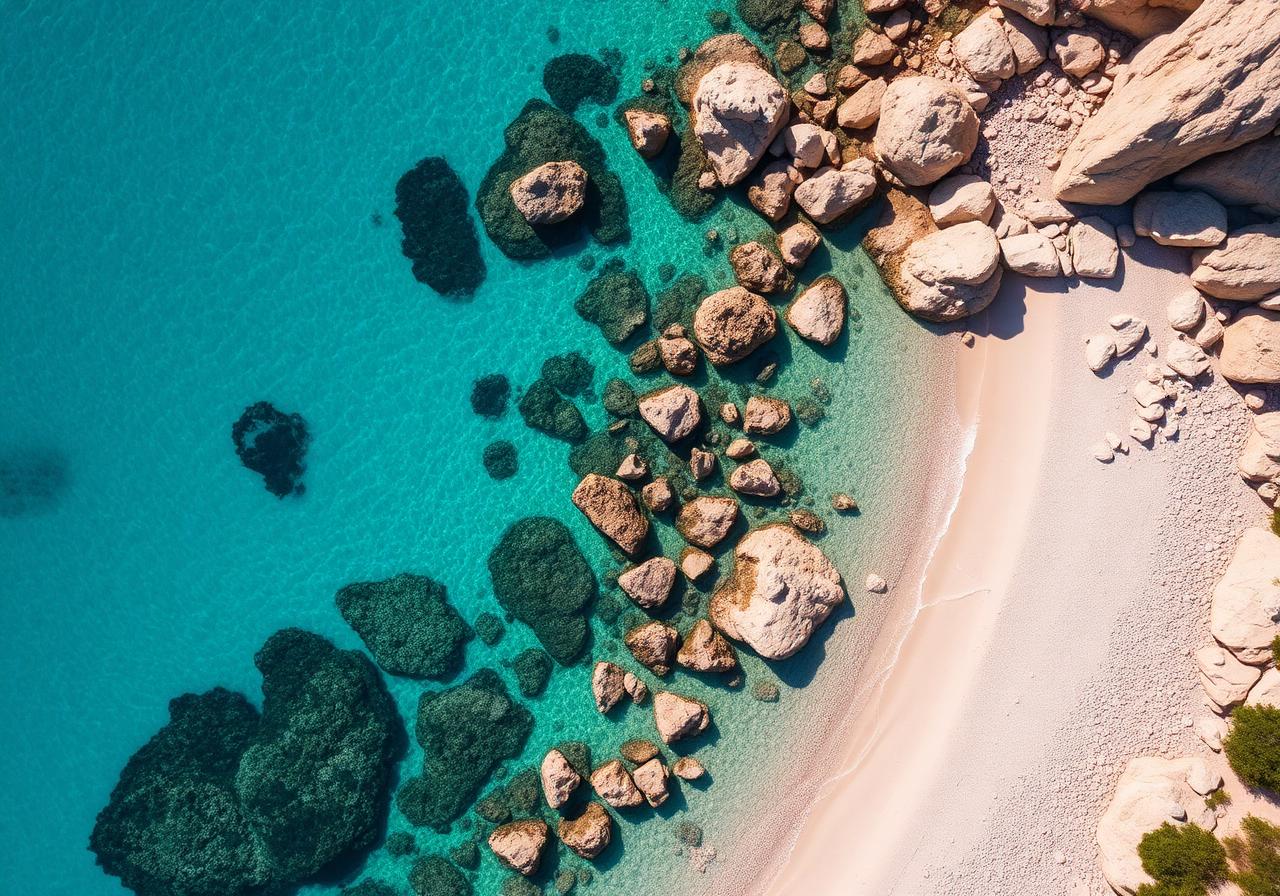
An island older than Italy itself: nuraghe stone towers, pasta you'll eat nowhere else, and water the colour of polished glass.
Five reasons Sardinia stays with you.
- Beaches that rival the Caribbean — La Pelosa, Cala Goloritzé
- 7,000 prehistoric nuraghe stone towers across the island
- A cuisine you'll find nowhere else — culurgiones, pane carasau
- Costa Smeralda glamour and untouched Ogliastra wilderness
- Cannonau — among the world's longest-lived red wines
Best time to visit · Late May–June and September. Sea is warmest in August.
An Island Older Than Italy
Sardinia is, in a real sense, older than Italy — a place that spent most of history belonging to itself. Long before Rome, a mysterious Bronze Age people built the nuraghi: conical stone towers, more than 7,000 of which still stand across the island, raised from around 1800 BC. No one fully knows what they were — defensible homesteads, watchtowers, temples — but no civilization elsewhere built anything quite like them. The same culture left the Giants' Tombs and the extraordinary stone statues of Mont'e Prama, possibly the oldest large sculptures in the Mediterranean after Egypt's.
From the 9th century BC the Phoenicians came as traders, then the Carthaginians as rulers, founding coastal cities like Tharros and Nora. Rome took the island after the First Punic War in 238 BC — but Sardinia's interior, the Barbagia, never fully bent to any conqueror, and the old culture survived in the mountains for centuries.
The Age of Judges, and a Little Barcelona
After Rome faded, Sardinia did something almost unique in medieval Europe: cut off and self-reliant, it governed itself through four independent kingdoms, the Giudicati. From this era comes one of its proudest figures — Eleonora d'Arborea, whose Carta de Logu of 1392 was among the most progressive legal codes of its time. Then the Crown of Aragon arrived in the 14th century, beginning four centuries of Iberian rule. Its deepest mark is Alghero, where the original population was replaced by Catalan settlers — and where, to this day, people still speak a Catalan dialect and the old town is known as "a little Barcelona."
A Culture of Its Own
The Savoyards took the island in 1720, and Sardinia eventually joined unified Italy — but it has never quite stopped being its own world. Its language is recognized as distinct, not a dialect of Italian; its cuisine — culurgiones, pane carasau, suckling pig, the long-lived Cannonau wine of one of the world's Blue Zones — is found nowhere else. Sardinians have always thought of themselves first as Sardinian. Spend a day inland and you'll understand why.
Start here if you have a long weekend.
Pink-sand bays and bronze-age mysteries.
Five doorways into Sardinia — each town with its own light, language, and rhythm.
Alghero
Catalan Sardinia — yellow stone bastions over a coral sea.
Bosa
Pastel houses descending to a slow river, crowned by a Malaspina castle.
Cagliari
A capital of bastioned views, Roman ruins and rough-edged glamour.
Castelsardo
A medieval citadel jutting into the Gulf of Asinara.
Orgosolo
Mountain village famous for political murals and centenarian shepherds.