Puglia
Sun-bleached stone, olive groves stretching to the horizon, and a cuisine built on bread, sea and fire. Puglia rewards the slow traveler.
Five reasons Puglia stays with you.
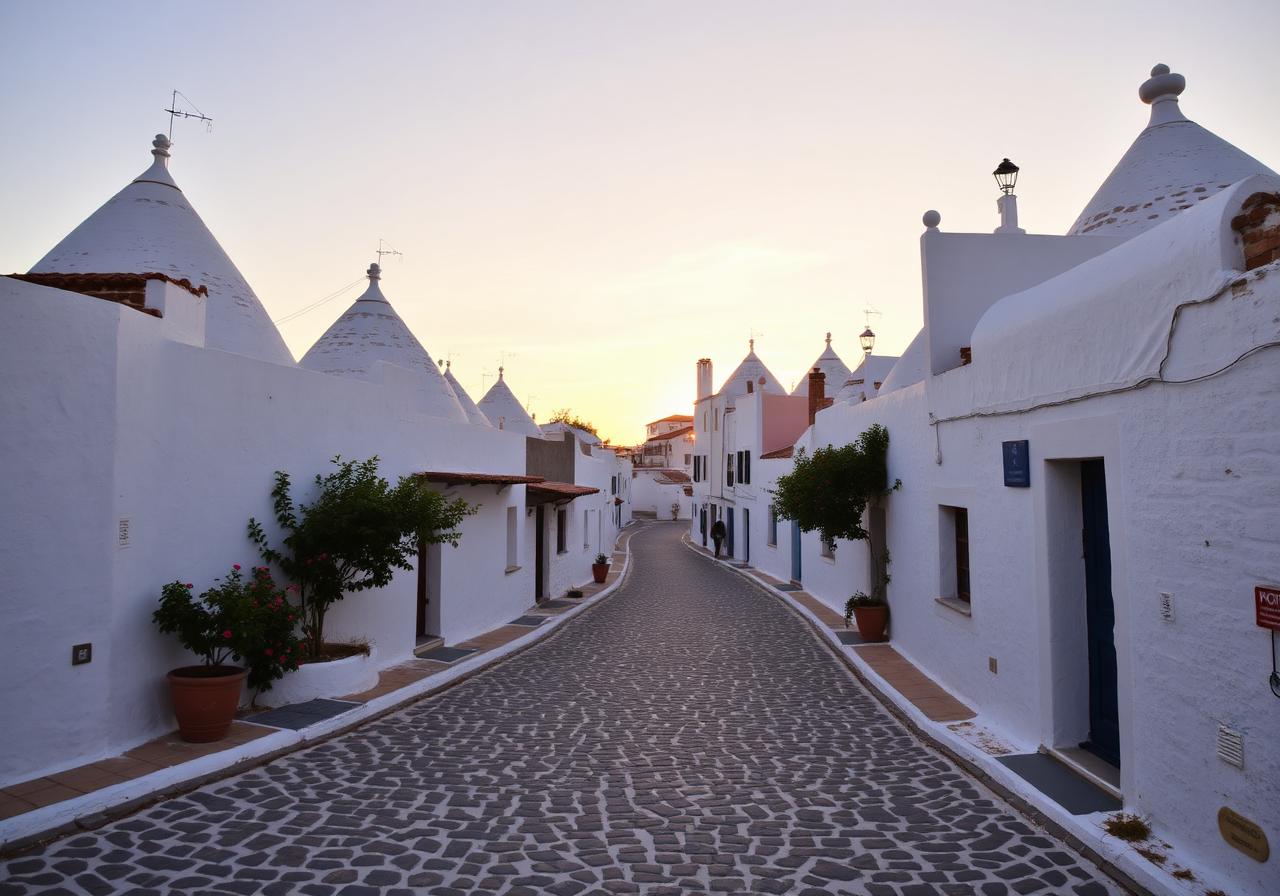
- Whitewashed trulli villages and UNESCO-listed Alberobello
- Two coastlines — Adriatic cliffs and Ionian sandbars
- Burrata, orecchiette, and the country's best olive oil
- Baroque Lecce — the 'Florence of the South'
- Boutique masseria farm-stays among centuries-old olive groves
Best time to visit · May–June and September–October. July–August is hot but coastal.
A Crossroads of Empires
Puglia has been settled since the Paleolithic — the Altamura man, an archaic Neanderthal, was found fossilized in its caves. By the first millennium BC, Illyrian peoples — the Daunians, Peucetians, and Messapians — farmed the heel, raising the menhirs and dolmens you can still find scattered across the Murge plateau. Then came the Greeks: from the 8th century BC, Taranto (Taras) grew into one of the great cities of Magna Graecia, and the Greek imprint never fully faded. In the deep south, the Griko communities around Calimera and Sternatia still speak an ancient Greek-rooted dialect, and the hypnotic pizzica dance carries the same inheritance.
Rome came next, drawn by Puglia's position as the bridge to the East. The Via Appia ran all the way to Brindisi, the empire's gateway to Greece, and the Roman amphitheatre still sits half-buried in the centre of Lecce. After Rome fell, the region passed through Lombard, Byzantine, and Saracen hands — Bari became a Byzantine capital, and that eastern influence lingers in the architecture and the local churches to this day.
In the 11th century the Normans took control, ushering in stability and a wave of cathedral-building in a distinctive blend of Romanesque, Byzantine, and Arab styles. The golden age followed under Frederick II — "Stupor Mundi," the wonder of the world — whose enlightened reign in the 13th century left castles across the region, including the enigmatic octagonal Castel del Monte.
The Baroque You See Today
Lecce's extraordinary baroque — the carved angels, flowers, and fantastical creatures that earned it the name "the Florence of the South" — flowered in the 1600s, made possible by a soft, golden local limestone (pietra leccese) ideal for the chisel. And the trulli, those conical drystone houses of the Itria Valley, have a famously practical origin: built without mortar so they could be pulled down quickly when the tax collector came through, then rebuilt once he'd gone.
A Region Built on Bread, Sea, and Fire
Puglia's cucina povera — "poor kitchen" — turns simple things into the region's soul: orecchiette by hand, burrata from the dairies around Andria, olive oil from groves of trees a thousand years old, and seafood straight off the Adriatic and Ionian boats. It is, by most accounts, the best-eating corner of Italy that the rest of Italy tries to keep secret.
Start here if you have a long weekend.
Whitewashed villages on the Adriatic heel.
Five doorways into Puglia — each town with its own light, language, and rhythm.
Alberobello
A UNESCO-listed dreamscape of trulli — conical limestone huts that look stitched into the earth.
Polignano a Mare
A whitewashed cliff town hanging over a turquoise grotto.
Ostuni
The 'Città Bianca' — a hilltop labyrinth of lime-washed alleys.
Lecce
The 'Florence of the South' — baroque sandstone glowing gold at dusk.
Otranto
Italy's easternmost town — Byzantine mosaics and a sapphire sea.